We are proud to offer international shipping services that currently operate in over 200 countries and islands world wide. Nothing means more to us than bringing our customers great value and service. We will continue to grow to meet the needs of all our customers, delivering a service beyond all expectation anywhere in the world.
How do you ship packages?
Packages from our warehouse in China will be shipped by ePacket or EMS depending on the weight and size of the product. Packages shipped from our US warehouse are shipped through USPS.
Do you ship worldwide?
Yes. We provide free shipping to over 200 countries around the world. However, there are some locations we are unable to ship to. If you happen to be located in one of those countries we will contact you.
What about customs?
We are not responsible for any custom fees once the items have shipped. By purchasing our products, you consent that one or more packages may be shipped to you and may get custom fees when they arrive to your country.
How long does shipping take?
Shipping time varies by location. These are our estimates:
| Location |
*Estimated Shipping Time |
| United States |
10-30 Business days |
| Canada, Europe |
10-30 Business days |
| Australia, New Zealand |
10-30 Business days |
| Central & South America |
15-30 Business days |
| Asia |
10-20 Business days |
| Africa |
15-45 Business days |
*This doesn’t include our 2-5 day processing time.
Do you provide tracking information?
Yes, you will receive an email once your order ships that contains your tracking information. If you haven’t received tracking info within 5 days, please contact us.
My tracking says “no information available at the moment”.
For some shipping companies, it takes 2-5 business days for the tracking information to update on the system. If your order was placed more than 5 business days ago and there is still no information on your tracking number, please contact us.
Will my items be sent in one package?
For logistical reasons, items in the same purchase will sometimes be sent in separate packages, even if you've specified combined shipping.
If you have any other questions, please contact us and we will do our best to help you out.
Order cancellation
All orders can be cancelled until they are shipped. If your order has been paid and you need to make a change or cancel an order, you must contact us within 12 hours. Once the packaging and shipping process has started, it can no longer be cancelled.
Refunds
Your satisfaction is our #1 priority. Therefore, you can request a refund or reshipment for ordered products if:
- If you did not receive the product within the guaranteed time( 45 days not including 2-5 day processing) you can request a refund or a reshipment.
- If you received the wrong item you can request a refund or a reshipment.
- If you do not want the product you’ve received you may request a refund but you must return the item at your expense and the item must be unused.
We do not issue the refund if:
- Your order did not arrive due to factors within your control (i.e. providing the wrong shipping address)
- Your order did not arrive due to exceptional circumstances outside the control of Clumet (i.e. not cleared by customs, delayed by a natural disaster).
- Other exceptional circumstances outside the control of https://desirabledropsvault.shop
*You can submit refund requests within 15 days after the guaranteed period for delivery (45 days) has expired. You can do it by sending a message on Contact Us page
If you are approved for a refund, then your refund will be processed, and a credit will automatically be applied to your credit card or original method of payment, within 14 days.
Exchanges
If for any reason you would like to exchange your product, perhaps for a different size in clothing. You must contact us first and we will guide you through the steps.
Please do not send your purchase back to us unless we authorise you to do so.


















The view calculator instantly showed me why my niche pays so differently across platforms.
Didn't realize the made-for-kids toggle could cut payout that dramatically until I tried it myself.
The Reach, Trust, Income breakdown finally explained why my views weren't converting to money.
Caitlin Rhodes posting to all seven platforms at once is such a clever solve for burnout.
I've been making parenting content on TikTok for almost a year, mostly quick clips of my toddler's bedtime chaos, and I genuinely had no idea why my view counts felt high but my actual income stayed embarrassingly low. Running my numbers through the calculator with a mixed global audience selected instead of the US/UK preset I'd been assuming was the eye-opener, since it showed exactly how much audience location was dragging my per-view rate down. The made-for-kids labeling warning hit even harder, because I realized two of my best-performing videos were probably getting flagged that way without me ever checking. I started keeping the camera pointed at me talking to the camera rather than at my son's face, following the guide's advice about content made for the adult watching rather than the child, and my next month's numbers on the same view count came in noticeably higher. It's a small shift in framing but it's clearly the difference between content that performs and content that actually pays.
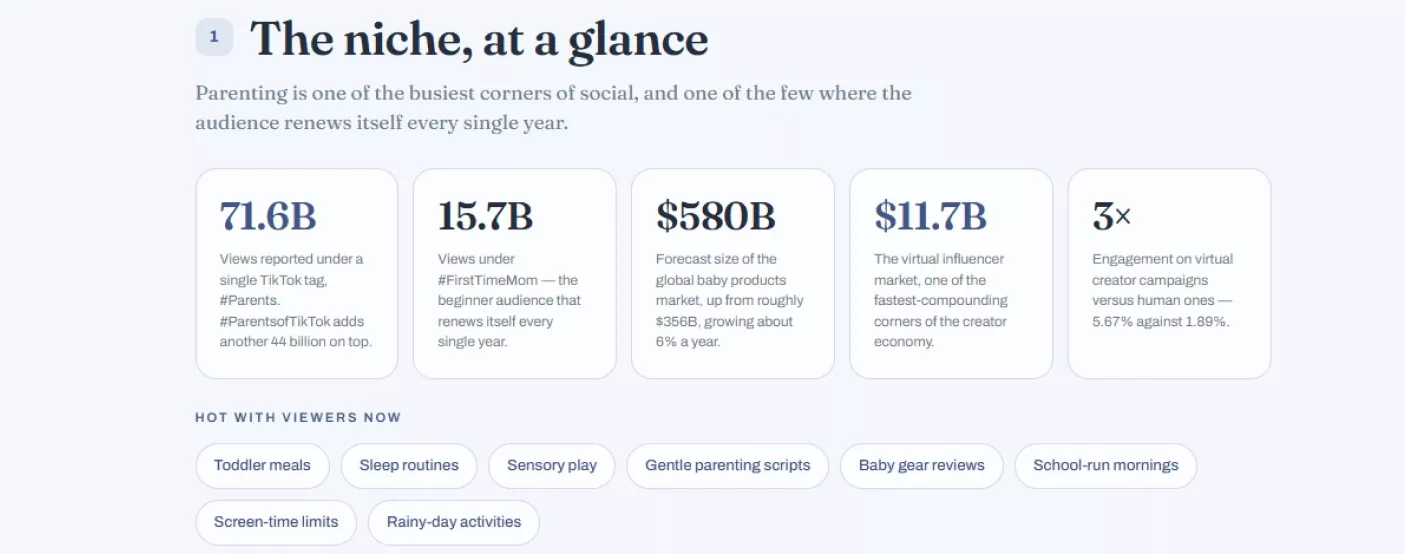
Good breakdown of the stats, though I wish the $11.7B virtual influencer figure had a source I could dig into further.
Never knew #FirstTimeMom alone had 15.7 billion views. That stat alone reframed the whole niche for me.
The one-idea-every-platform framing changed how I plan my filming days entirely.
Solid tool, though the slider jumps a bit oddly between the 500K and 1M presets.
The three-stage reach, trust, income model is the clearest explanation of creator income I've seen.
Genuinely useful for anyone confused about why views don't equal money 📊
Caitlin Rhodes solving the child-privacy problem is honestly the smartest part of this whole thing.
The 3x engagement stat for virtual creators versus human ones stopped me mid-scroll.
I run a small parenting account and had been posting my daughter's face on every platform without thinking twice about it, until the section on keeping names, schools, and locations out of content actually made me stop and reconsider what I'd already published. I went back through six months of posts and realized how much identifying detail had slipped in without me noticing, from her daycare's logo in the background to her actual first name in half my captions. Switching to a persona-style approach for new content, keeping the camera further back and leaning on voiceover instead of her talking directly to camera, felt awkward at first, but the guide's point about anything posted being permanent stuck with me hard. My views dipped slightly at first from the change in style, but knowing I'm not spending my kid's privacy for content has genuinely made me feel better about doing this at all.
The audience toggle between global mix and US/UK made the earnings gap obvious immediately.
Really clear tool, wish it broke down more platforms individually with their own presets.
The baby products market stat growing toward $580B put my tiny niche in serious perspective.
This is the first resource that actually explained why my niche specifically has this renewing audience every year.
Simple interface, real numbers, no fluff around it.
The reshape-one-idea-for-every-platform section is basically a whole content strategy in three paragraphs.
I make short parenting videos as a side hustle around a full-time job, and for the longest time I only bothered with TikTok because filming for multiple platforms felt like triple the work for the same idea. The one-idea-every-platform section reframed that completely, pointing out that one afternoon of filming becomes a week of content everywhere instead of one exhausting shoot per platform. I tested it with a single sensory-play video, cutting it short for Reels and TikTok, stretching the same footage into a longer YouTube version with more explanation, and turning stills from the shoot into an Instagram carousel. The carousel alone brought in more genuine engagement than any of my short clips had in months, which the guide's point about photos and carousels building trust actually predicted. My total weekly output tripled without me filming a single extra minute, which honestly felt like cheating in the best way.
Straightforward tool, does exactly what it says on the label.
Good stats overview, though I wanted more detail on how the AI creator persona actually gets built.
The hot topics list matches exactly what's been working in my own feed lately.
Never really understood why my content kept getting flagged as low-earning until the made-for-kids explanation clicked.
This is the clearest, most direct explanation of creator economics for this niche.
The engagement gap between virtual and human creators is a genuinely surprising number.
I've been a stay-at-home dad posting parenting content on the side for about two years now, mostly on Instagram since that felt the most comfortable, and I'd never bothered checking how much money I was actually leaving on the table by staying on one platform. Running the calculator with my rough monthly views and switching between the audience presets showed a bigger gap than I expected between a mixed global audience and a mostly US/UK one, which explained a lot about why some of my best months still felt underwhelming financially. The reach-trust-income model made me realize I'd been stuck entirely at the reach stage, posting short clips without ever building the kind of trust that actually converts into brand deals or affiliate income. I started adding longer YouTube videos going deeper into the same routines I was already filming for Instagram, and within six weeks had my first small brand outreach email, something that had never happened once in two years of Instagram-only posting.
Wish the tool let you save different scenarios to compare side by side.
The stat about #Parents alone hitting 71.6 billion views is staggering to actually sit with.
This finally explained the gap between my view counts and my actual bank account.
The idea of an AI creator that never burns out is a genuinely smart pitch for this specific niche.
Simple, sharp, and the math is transparent rather than vague.
I've always felt a little uneasy posting my kids online even though it's been my main source of side income for the past year, and this is the first resource I've read that actually names that discomfort directly instead of glossing over it. The section on keeping identifying details out of content, and the note about anything posted being permanent, sat with me for a couple of days before I made any real changes. I ended up experimenting with Caitlin Rhodes as a way to test the AI-creator idea rather than committing my own kids' faces to more content, reshaping a rainy-day activities script I'd already written for my own videos into something she could post instead. The engagement wasn't wildly different from my usual numbers, and honestly it was a relief to post something without that low hum of second-guessing myself about my kids' privacy every single time.
The slider updating live across all seven platforms at once is oddly satisfying to play with.
Good overview, though the school-run mornings trend mentioned briefly deserved its own section.
The trust stage explanation finally made brand deals make sense to me as a beginner.
Practical, numbers-driven, and refreshingly honest about what's a guarantee and what isn't.
This is the first tool that actually quantified how much audience location matters for payout.
I run a small YouTube channel about gentle parenting scripts that I started almost accidentally after posting one video about handling toddler meltdowns without yelling, and it's grown slowly but steadily since. Reading the reach-trust-income breakdown made me realize why my slower, more deliberate growth on YouTube was actually healthier long term than the spiky, unpredictable growth I'd seen on a short-lived TikTok account I'd tried before. The stat about #Parents hashtag views being in the tens of billions put into perspective just how much competition exists on the short-video side, while my longer, more thoughtful videos were quietly building something the calculator's trust stage described almost exactly. I started reshaping my existing YouTube scripts into short clips and carousels for other platforms instead of trying to create separate content from scratch, and my overall reach finally started catching up to the trust I'd already built.
Genuinely eye-opening stats section, wish it credited more direct primary sources though.
The AI creator angle solves a problem I didn't even realize I had until reading this.
This made me actually understand what 'trust' means as a monetization lever, not just a buzzword.
Clean design, real math, exactly what a creator actually needs to plan around.
I've been filming my daughter's sensory play activities for close to a year now, treating it mostly as a fun side project rather than an actual income source, and this changed how seriously I'm taking it. Testing the calculator with a US/UK audience selected versus a global mix showed me exactly why some of my videos that got fewer views actually made more sense financially than my viral ones with a mostly international audience. The made-for-kids warning made me go back and re-check how a few of my videos were probably classified, since some featured her talking directly at the camera in a way that likely reads as content for children rather than for the parents watching. I adjusted my filming style to center more on my own voice explaining the activity rather than her performing for the camera, and the shift felt small on my end but the guide's explanation made it clear why that distinction matters so much for actual payout.
The seven-platform stacking idea is such an obvious strategy once you see it laid out.
Solid resource, though I'd like to see the numbers broken down by specific sub-niche rather than parenting broadly.
The market size stats alone made this niche feel a lot less crowded than I assumed.
This is a genuinely smart, well-organized breakdown of creator income in this space.
Never thought about how permanent a posted video actually is until this guide put it plainly.
Direct, useful, and it doesn't oversell what a view is actually worth.
I quit my office job eight months ago to try creator work full time, mostly posting toddler meal ideas since that's what I actually cook for my own kids daily, and it's been a slower build than I expected going in. The calculator's honesty about views being the top of the funnel rather than the whole business is what finally got me to stop obsessing over view counts and start actually tracking whether people were sticking around. I leaned into the trust stage hard, answering every single comment for a few months, and started seeing affiliate link clicks pick up well before my view counts themselves grew much. Eight months in, my income is still modest, but it's real, steady, and growing in a way that finally matches what this guide described rather than the overnight-viral fantasy I'd walked in expecting.
Good structure, though I wish the platform rate ranges were updated more frequently.
The idea that virtual creators outperform human ones on engagement genuinely surprised me.
This is exactly the kind of honest, numbers-first resource this niche needed.
Simple to use, and the live math actually feels trustworthy rather than gimmicky.
I never really understood affiliate income until the third stage of this guide's model finally connected the dots for me.
I run a small home daycare and started filming morning drop-off routines almost by accident after a parent asked me to record her daughter's first day for her. What began as one video turned into a small following, and this guide is what finally helped me understand how to actually make money from it instead of just posting for fun. The three-stage model made it clear I was stuck purely at reach with almost no trust built, since I was posting inconsistently and never really engaging with comments. I committed to weekly posts about school-run mornings, one of the exact trending topics listed here, and answered every comment for two months straight. My first small brand partnership offer came in right around week seven, for a lunchbox company, which felt like proof the model actually works rather than just sounding good on paper.
The stat comparisons between platforms made choosing where to focus so much easier.
Great resource, though a mobile-friendly version of the calculator would help a lot.
This finally gave me real numbers instead of vague creator economy hype.
The privacy point about kids not being able to consent to being published really stuck with me.
Clear, honest, and it doesn't pretend views alone will pay the bills.
I've always filmed my kids for my parenting page without a second thought since everyone in my circle does the same thing, so the section calling out school names and locations as things to strip out actually stopped me mid-scroll while reading. I went back and audited about forty old posts and found more identifying detail than I expected, including our actual street visible in one background shot. Since then I've shifted toward filming activities and routines without lingering on faces, using voiceover to carry the personality of the content instead. It changed the feel of my page a bit, more focused on the parent's voice than the kid's face, but it also lines up with exactly what the guide says earns the higher-paying tier since the content now clearly reads as being made for the adult watching.
The screen-time limits topic being listed as trending matched exactly what my audience keeps asking about.
Really informative, though I wanted a clearer explanation of how the virtual influencer market number was calculated.
The seven platforms at once framing through Caitlin Rhodes is a genuinely clever pitch.
Practical numbers, no vague promises anywhere in it 👏
This is the most grounded breakdown of creator income I've read in this niche.
I started a small parenting TikTok almost two years ago after my second kid was born, mostly as a way to feel less isolated during those long newborn nights, and it slowly turned into a real audience without me ever planning for it to become income. This guide's stat about #FirstTimeMom having 15.7 billion views alone made me realize just how large and renewing this specific corner of the audience actually is, since that's exactly the phase I'd been documenting from the start. The made-for-kids warning made me rethink a few videos where my newborn was clearly the main subject rather than my own experience narrating alongside her, and I started reframing my captions and framing to center my voice more. Two years in, what started as a coping mechanism during sleepless nights is now bringing in a small but real monthly income, almost entirely thanks to finally understanding why some of my videos performed so differently from others.
The whole idea of one filming session becoming a week of content across platforms is brilliant.
Solid tool overall, wish there was a way to factor in sponsorship income alongside view payouts.
This gave me language for something I'd felt intuitively but never articulated about my content strategy.
Genuinely useful stats, direct and easy to act on immediately.
I make gentle parenting script videos as basically my only source of income now after leaving a teaching job I burned out on two years ago, and this guide's honesty about the made-for-kids labeling issue explained something that had been quietly hurting my payouts for months without me realizing it. Several of my best-performing scripts featured my son responding directly to the camera in a way that almost certainly read as content aimed at him rather than at the parents watching, cutting off the higher ad tier without me ever knowing that was happening. I reworked my format to have him in the background while I narrate the script directly to camera instead, and within a month my per-view rate on a similar view count had visibly improved. It's the kind of detail that's completely invisible until someone spells it out, and it's probably cost me real money over the past two years without me ever suspecting the format itself was the problem.
The audience location lever is honestly the single most useful insight in the whole thing.
Good resource, though I'd like a version that accounts for shorts monetization changes over time.
The reach-trust-income model is now basically how I plan my entire content calendar.
Clear, honest, and refreshingly free of overnight-success promises.
Never realized virtual creators could actually outperform human ones on engagement until this stat.
I'm a nanny who started filming baby gear reviews for extra income during nap times, mostly borrowing products I already use professionally rather than buying new things just for content. This guide's point about content needing to build trust before it converts into anything meaningful reframed how patient I needed to be with my slow, review-focused niche, since gear reviews build a very specific kind of credibility over time rather than going viral overnight. Running my modest view counts through the calculator with a mostly US/UK audience selected showed rates high enough to actually justify the time I was spending, which reassured me I wasn't wasting hours for nothing. A year in, affiliate links from those same gear reviews now bring in more than the view payouts themselves ever did, exactly the shift toward stage-three income this guide predicted for a review-based niche like mine.
Solid overview, though a glossary of platform-specific terms would help newcomers a lot.
The market size numbers here made me take this niche way more seriously as an actual business.
This is such a clear, no-hype breakdown of how creator income actually works.
The child privacy section is something every parenting creator should honestly read twice.
I've run a small Instagram page sharing screen-time limit tips for about three years now, treating it as a hobby that occasionally brought in a little affiliate money here and there, never anything I took seriously as income. Reading through the platform breakdown and testing different view counts through the calculator showed me that Instagram carousels specifically, which is basically all I post, sit in a different payout category than short video entirely, something I'd never actually understood before. The trust-building explanation matched my own slow growth pattern almost perfectly, since my audience is small but unusually engaged for its size, exactly the kind of following the guide says converts well even without huge view counts. I started reshaping my carousels into short video clips for Reels too, following the one-idea-every-platform advice, and my reach finally started catching up to the trust I'd quietly built over those three slower years.
Good tool, though I'd like to see a rough estimate of typical brand deal rates included too.
The stat comparison between #Parents and #ParentsofTikTok shows just how massive this audience actually is.
This is genuinely the most useful creator-economics resource I've found for this specific niche.
Simple slider, honest math, no exaggerated promises anywhere 🌙
The rainy-day activities trend listed here is exactly what's been performing on my page too.
I've been posting toddler meal videos for about a year now on the side of my main job as a dietitian, treating the whole thing as a fun outlet rather than income at first, but the numbers in this guide made me reconsider that. Comparing a global mix audience against a mostly US/UK one through the calculator showed a payout gap large enough that I started actually paying attention to who was watching rather than just how many, something I'd never bothered checking before. The professional credibility I already had as a dietitian turned out to be exactly the trust-building advantage this niche rewards, since my followers clearly trust my food advice more than a typical lifestyle creator's. Combining that existing trust with a more deliberate content spread across platforms, following the one-idea-everywhere approach, doubled my monthly views within two months without me filming any more than I already was.
Great resource overall, though the AI creator section could use a concrete pricing example.
This is the tool I wish existed when I first started posting parenting content years ago.
The made-for-kids explanation alone probably saved me real money going forward.
Clean, honest, and it treats the reader like they can handle real numbers.
I've filmed my three kids for a small parenting YouTube channel for almost four years now, long before I ever thought about any of this seriously as income, and this guide made me look back at that whole archive with fresh eyes. The point about anything posted being permanent hit hardest since my oldest is now old enough to have opinions about videos from when she was four, opinions I hadn't really considered before reading this. Going forward I've started involving my kids in the decision of what gets filmed, something the guide doesn't explicitly say but that its privacy framing nudged me toward on my own. Income-wise, understanding the reach-trust-income model finally explained why my oldest, most trust-built videos from years ago still quietly outperform flashier recent ones, which changed how I think about my content calendar for the next four years too.
Good stats section, wish the sourcing footnotes were a bit more prominent.
The seven-platform strategy explained here is honestly a whole business plan in miniature.
This is the clearest, most useful thing I've read about parenting creator income specifically.
The virtual creator engagement stat is going to change how I think about my whole strategy.
I quit posting my daughter's face online about a year ago after a scare with a stranger commenting something unsettling, and I'd honestly assumed that meant giving up the small income I'd built entirely. This guide's whole framing around an AI creator like Caitlin Rhodes solving exactly this trade-off felt like it was speaking directly to my exact situation, since I'd been searching for a way to keep the content going without my daughter's actual face in it. I started scripting the same rainy-day activities and sensory play ideas I used to film with her, but reshaping them into voiceover-led content instead, testing whether the ideas alone could carry the engagement without her being visible. It's still early, but the engagement hasn't collapsed the way I feared it would, and for the first time since that scare I feel like I can keep doing this without that constant low-grade worry sitting in the back of my mind.
Solid overview, though I'd like more detail on how brand partnerships actually get pitched.
The baby products market stat put my whole niche in a completely different light for me.
This tool made the math behind creator income finally click for me.
Direct and useful, exactly what a beginner creator actually needs 📈
The renewing-audience point about new parents every year is such an underrated advantage of this niche.
I started my parenting page mostly to document my son's early years for family who live far away, never expecting strangers to find it, let alone pay attention to it the way they eventually did. When the following grew large enough that a few brands started reaching out, I had no idea how to value what I was being offered, and this guide's payout ranges gave me the first real benchmark I'd ever had to compare against. Understanding the reach-trust-income model also explained why the brands reaching out were consistently ones tied to the specific routines I posted most consistently about, rather than random unrelated products, which lines up exactly with the trust-stage explanation about niche credibility mattering more than raw follower count. I still keep the content mostly for family at heart, but now I actually know what a fair deal looks like when one comes along instead of guessing.
Great resource, though a printable summary of the key stats would be a nice addition.
The whole thing reads like it was written by someone who actually understands this niche deeply.
This is exactly the resource I needed before pitching my first brand partnership.
Simple and clear, the live math makes the numbers feel real instead of abstract.
I run a modest gentle-parenting-scripts page and had assumed for a long time that my slower, steadier growth meant I was doing something wrong compared to creators with flashier viral spikes. Reading the trust stage explanation reframed that completely, since it points out directly that nobody takes parenting advice from a stranger they doubt, which is basically the entire premise my page has been quietly built on without me realizing it had a name. Comparing my actual numbers through the calculator against a rough viral scenario showed my steadier engagement converting at a rate that a much bigger, flashier account with a colder audience might not match at all. It was oddly validating to have a framework actually explain why my approach, slow as it's felt, was the right one for building something that lasts rather than something that spikes and disappears.
Good tool overall, wish it explained how seasonal trends like back-to-school affect the numbers.
The stat about audience location being the single biggest lever genuinely reframed my strategy.
This is a genuinely well-built, honest tool for understanding creator income.
Clean and useful, no exaggerated numbers anywhere in it.
I've been a full-time parenting creator for almost three years now, and even after all that time this is the first resource that actually laid out why my TikTok views and my actual income have felt so disconnected from each other. The made-for-kids labeling section explained a dip in earnings I'd noticed about a year ago right after I started letting my daughter talk more directly to camera, something I'd chalked up to algorithm changes instead of realizing it was a classification issue the whole time. Going back and reworking my format so I'm narrating to the camera with her present but not performing directly at it brought my per-view rate back up within about a month, almost exactly matching what it had been before that shift happened. Three years in, I'm still learning things about this niche I thought I already understood, and this guide corrected a mistake that had quietly cost me money for over a year.
Solid resource, though the hot topics list could use monthly updates to stay current.
The whole seven-platforms-at-once idea through an AI persona is a genuinely fresh angle.
Really clear breakdown, appreciated the honesty about payouts moving with terms constantly.
This tool made me finally understand why my views and income never lined up 🔥
I make baby gear review content that started as genuine recommendations for friends before I ever thought of it as income, and this guide's affiliate-focused explanation of the income stage matched my experience almost exactly once I actually paid attention. The calculator showed how modest my raw view payouts really were compared to what my affiliate links were quietly bringing in each month, a gap I'd never actually measured before running the numbers side by side like this. The reach-trust point about nobody trusting advice from a stranger explained why my reviews specifically, built on years of just being a mom talking honestly about gear I actually use, converted so much better than flashier unboxing videos from bigger accounts with less obvious personal use. It didn't change what I make necessarily, but it gave me language and numbers for something I'd been doing mostly on instinct for years.
Good overview, though I'd like a version tailored to grandparent-focused content too.
The permanence warning about posted content is something every new creator needs to actually sit with.
This is genuinely one of the more thoughtful creator economy breakdowns I've read.
Simple tool, real numbers, exactly what I needed before negotiating my first deal.
I run a small daycare-adjacent parenting page mostly built around school-run morning routines, since that's genuinely the chaos I live daily with my own three kids, and I never expected this specific slice of content to have its own dedicated attention in a guide like this. Seeing it listed as a currently hot topic validated something I'd noticed in my own numbers over the past few months, where morning routine videos consistently outperformed almost everything else I posted. The three-stage model helped me understand why, since morning chaos content builds trust fast, everyone recognizes the specific frustration instantly, and that recognition seems to convert into engagement quicker than more polished, aspirational content ever did for me. Understanding that this particular topic is trending niche-wide, not just performing well for me personally, gave me the confidence to lean into it harder instead of second-guessing whether I was just repeating myself too much.
Great tool overall, though the presets jump a bit too far between 100K and 500K.
The AI creator concept for this niche specifically makes so much sense once you read the privacy section.
This gave me real numbers to finally plan around instead of guessing at my worth.
Honest, direct, and it doesn't oversell what any single platform can do alone.
I started documenting my toddler's sleep routine struggles on Instagram almost two years ago purely as a way to vent and connect with other exhausted parents, never once thinking about monetizing any of it seriously until a small brand reached out unprompted. This guide's payout ranges gave me my first real sense of whether what they were offering was even fair, since I had absolutely nothing to compare it against before finding this. The reach-trust-income model also explained something I'd noticed but never articulated, that my most vulnerable, honestly-written posts about our worst nights consistently outperformed anything more polished or aspirational I tried posting instead. Understanding that vulnerability specifically builds the trust this niche runs on, rather than just being an emotional overshare, changed how deliberately I write my captions now instead of second-guessing whether I'm sharing too much.
Solid resource, wish it addressed how algorithm changes affect these numbers over time.
The stat comparing baby product market growth to the creator economy is such a smart framing choice.
This is exactly the kind of grounded, numbers-first tool this niche has needed for a while.
Clean, useful, and the live calculator genuinely helps you plan realistically 💛
I've run a modest parenting page focused on sensory play activities for my autistic son for the past two years, mostly as a way to find other parents navigating similar territory, and monetization was never really the point until slowly it started to matter more as our family's expenses grew. This guide's honesty about views being the top of the funnel rather than the whole business kept me from chasing view counts the way I'd started to, and pushed me to focus instead on the specific, smaller audience that actually needed what I was posting. The trust-stage explanation matched exactly why my modest following converts unusually well, since sensory play content for a specific need builds a very deep, specific kind of trust that broader parenting content probably can't replicate as easily. Two years in, the income is still modest, but it's grown steadily in a way that finally matches the honest, non-hype framing this guide uses throughout.
Good tool, though I wish the audience toggle had more granular regional options.
The whole framing around Caitlin Rhodes never burning out is a genuinely clever way to explain the AI creator idea.
Direct, clear, and it respects the reader enough to show real numbers instead of hype.
This finally explained the exact mechanism behind why some of my videos underperform financially.
I've been posting parenting content across just Instagram and TikTok for about a year and a half, always assuming spreading myself across more platforms would mean spreading myself too thin to actually keep up with any of them well. The one-idea-every-platform section changed my mind entirely by reframing it as reshaping rather than recreating, which felt like a much smaller lift than I'd been imagining. I tested it with a single toddler-meals video, trimming it down for Reels and TikTok, stretching the same footage with more explanation for a first YouTube attempt, and pulling stills for a carousel I'd never have thought to make otherwise. The YouTube version alone brought in a small but real payout on a fraction of the views my short clips usually get, exactly the higher-pay, more-depth pattern the guide describes for longer video, and it convinced me to finally stop avoiding YouTube out of intimidation.
Solid overview, though I'd like to see how these numbers shift during peak seasons like the holidays.
The renewing-audience angle on new parents is genuinely the smartest point in the whole guide.
This is a refreshingly honest, well-built tool for a niche that's usually full of hype.
Clean interface, transparent math, no exaggerated promises anywhere in sight.
I run a small parenting podcast that I eventually started clipping into short videos for social media, mostly out of curiosity about whether audio content could translate at all to a visual-first platform like TikTok. The reach-trust-income model explained why my clips, despite modest view counts compared to bigger accounts, converted into podcast listens and eventually a couple of small sponsorships at a rate that surprised me given how small my short-video following actually was. Understanding that trust compounds across formats rather than resetting on each new platform helped me stop worrying that my clips needed to go viral on their own merit, since they were really just doorways back into a much deeper, more trusted format I'd already built. A year into clipping the podcast this way, sponsorship income now covers a meaningful chunk of our production costs, something I genuinely didn't expect from what started as a curious experiment.
Good resource overall, though a case study from an actual creator would help ground the numbers.
The stat about #ParentsofTikTok adding another 44 billion views on top is genuinely wild to sit with.
This is the most useful, least hyped-up creator resource I've read in a long time.
Simple, sharp, and it treats the reader like an adult who can handle real math ⭐
I started making rainy-day activity videos almost by accident during a stretch of bad weather that kept my kids indoors for nearly two weeks straight, filming mostly to keep myself sane during that stretch rather than planning any kind of content strategy. Seeing rainy-day activities listed as a currently hot topic here made me realize the videos I'd made half out of desperation were actually sitting exactly on trend, which explained why they'd quietly outperformed content I'd put much more deliberate effort into. Running my modest numbers through the calculator with a global audience selected showed a payout that, while not huge, was clearly better than I'd assumed for content I'd made almost as an afterthought. It's a strange kind of validation, learning that the content born out of pure survival-mode parenting was actually my most strategically sound work without me trying at all.
Great tool, wish there was an export option to save my calculated scenarios.
The whole guide reads like it was written by someone who's actually navigated this niche themselves.
Genuinely useful, clear math, no wasted words anywhere in it.